
Every week, restaurant and cafe owners type the same questions into Google. Does a loyalty program actually pay off? Will it work with my POS? What about my second location?
We pulled the most common ones — the questions we hear from coffee shop owners, fast-casual operators, and independent restaurateurs alike — and answered them honestly. No fluff, no vague promises. Just clear answers and real examples.
Do loyalty programs actually make a difference for restaurants and cafes?
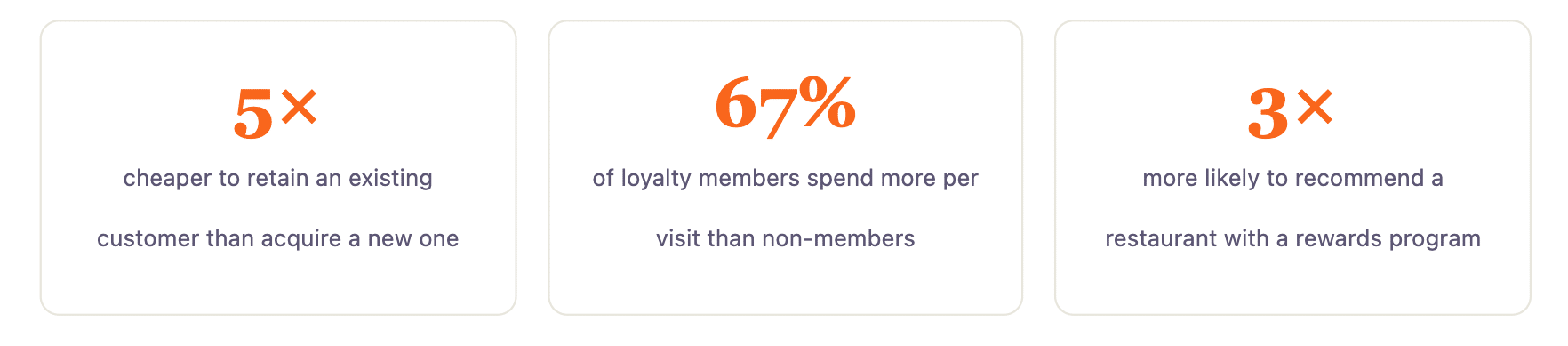
Short answer: yes — and the data is hard to argue with. Loyalty members visit more frequently, spend more per transaction, and are significantly more likely to recommend you to a friend. For a cafe, that means the difference between a customer who visits twice a month and one who visits five times. For a full-service restaurant, it often means a 15–25% lift in average spend when a reward is close to unlocking.
But the bigger shift is what a loyalty program does to your relationship with customers. Instead of hoping a guest comes back, you have a direct line to them — their birthday, their visit history, their preferences. That’s a fundamentally different business than one built on foot traffic and hope.
The Real Advantage
Loyalty programs don’t just reward customers. They give you data — who’s coming back, how often, what they order, when they lapse. That data is worth more than any punch card discount.
The shift from punch cards to digital loyalty is also worth noting. Physical punch cards get lost, shared, and forgotten. A digital program on a customer’s phone travels with them, sends reminders, and actually brings people back. The difference in redemption rates alone can be dramatic.
Does it integrate with our POS — like Lightspeed, Square, Toast, or Clover?
This is the first question most operators ask, and rightly so. A loyalty program that lives outside your POS creates friction — for staff who have to manually enter points, and for customers who have to remember to mention their account. Both are silent killers of adoption.
Kangaroo Rewards integrates directly with the POS systems restaurants actually use. Points are earned and redeemed right at checkout — no extra steps, no separate tablet just for loyalty, no staff training headaches.
And for operators running custom or proprietary systems, Kangaroo Rewards also offers a full API — so your development team can build a smooth, native connection between your existing tech stack and our loyalty engine. No workarounds, no manual syncing, no data gaps.
Integration also means your loyalty data and your sales data talk to each other. You can see which loyalty members order what, which reward tier drives the most return visits, and how your program affects average check size — all from one dashboard.
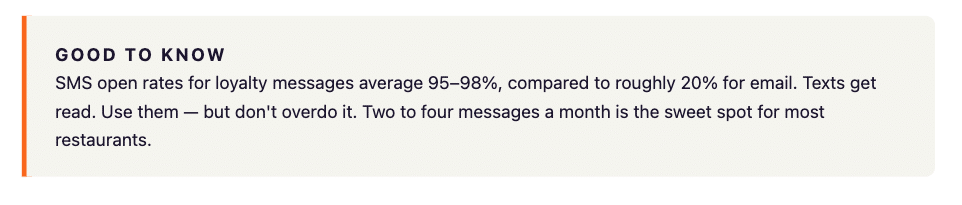
Can I send texts when a customer’s reward is ready?
Yes — and this is one of the most underused features in restaurant loyalty. Most operators set up their program and then wait for customers to come back. The smart operators flip that: they use automated notifications to pull customers back in.
- Reward-ready alerts. Customers get an SMS or push notification the moment they hit a reward threshold. The reminder alone drives incremental visits that would otherwise never happen.
- Birthday offers. Automated birthday messages with a personalized reward feel thoughtful — and they consistently deliver the highest redemption rates of any campaign type.
- Win-back campaigns. Customers who haven’t visited in 30, 60, or 90 days automatically receive a “we miss you” message with a time-sensitive offer. This recovers a meaningful percentage of at-risk regulars.
- Promo blasts. Running a Tuesday special or a slow-day promotion? Send it directly to your loyalty members — the people most likely to act on it.
What if I have multiple locations?
Multi-location support is built into Kangaroo Rewards — it’s not an afterthought. Whether you’re running two cafes across town or a regional chain, your customers can earn and redeem rewards at any location, and you manage everything from a single dashboard.
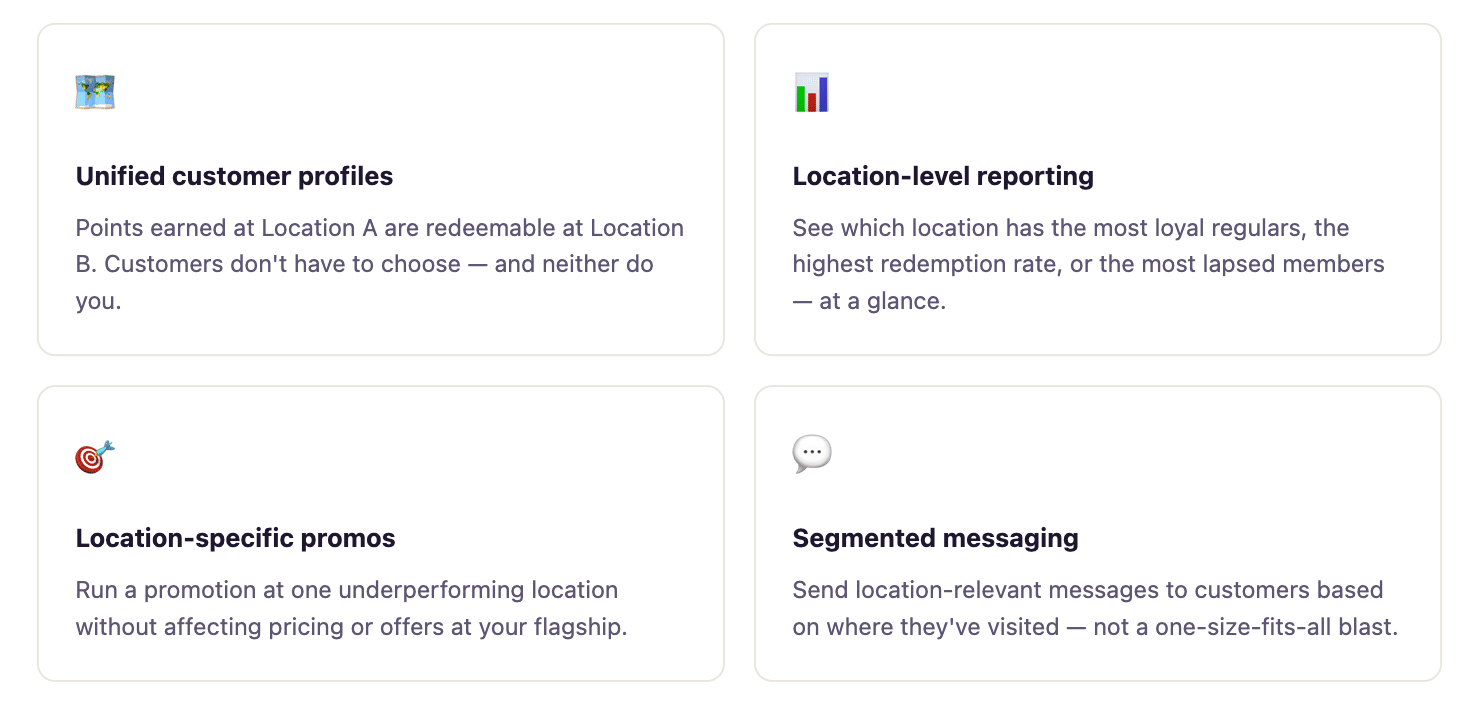
For growing operators, this infrastructure matters early. Starting with a system that scales means you don’t have to migrate or retrain when you open your third or fourth location.
Is a loyalty program actually worth it for a non-chain, independent restaurant?
This might be the most honest question in this whole post — and the answer is a clear yes, with a caveat worth explaining.
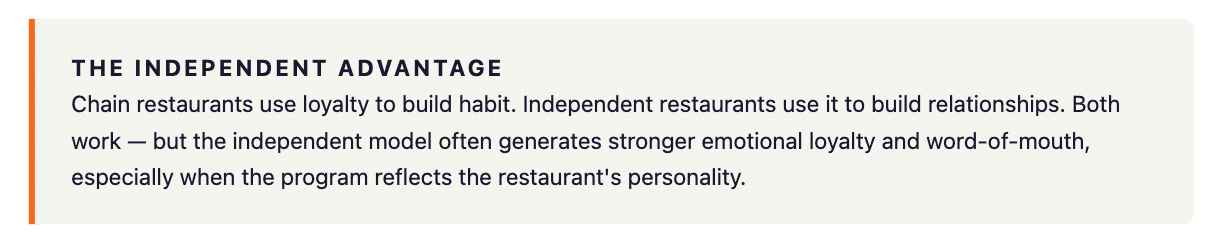
Independent restaurants often assume loyalty programs are a big-chain thing: complex, expensive, and designed for scale. That was true fifteen years ago. It’s not true now. Modern loyalty platforms are built for single-location operators, and the economics work just as well — often better — because you have something chains don’t: a genuine relationship with your regulars.
A loyalty program gives you tools to formalize and extend that relationship. You stop relying on a customer’s memory or habit to bring them back, and start using data and direct communication to stay top of mind.
The caveat: a loyalty program isn’t a substitute for great food and hospitality. It amplifies what’s already good. If your core experience is strong, a well-run loyalty program compounds that. If the experience is inconsistent, no amount of points will build the retention you’re looking for.
What are some unique and effective loyalty ideas for small restaurants?
The most effective programs are ones that feel like they belong to that specific restaurant — not a generic “earn 1 point per dollar” setup that every chain already does. Here are ideas that work especially well for independent operators:
- “Chef’s Table” tier for top regulars. Invite your top 5% of members to an exclusive tasting, early menu preview, or behind-the-scenes event. Costs almost nothing, creates tremendous loyalty and word of mouth.
- Stamp-free digital “frequent visitor” programs. Replace punch cards with a digital version — but add a surprise reward at an unexpected threshold (e.g. visit 7 times this month, get a free dessert). The surprise element outperforms predictable rewards.
- Social referral bonuses. Reward customers who bring in a friend — both the referrer and the new guest get points. This turns your loyalty base into an acquisition engine.
- Seasonal or local tie-ins. Double points during local events, food festivals, or slow seasons. Frame it around your community — “Farmers Market Saturday Double Points” feels relevant in a way that “2X Tuesday” doesn’t.
- Milestone rewards that feel personal. First visit, 10th visit, 1-year anniversary as a member — mark these moments with a personalized message and a small reward. The gesture costs almost nothing and creates genuine warmth.
How can I stop losing customers to competitors — and increase walk-ins?
This is where loyalty programs go from “nice to have” to “competitive advantage.” Most restaurants think of loyalty as a retention tool — and it is. But the best operators also use it as an acquisition and activation tool, particularly through a feature called geofencing.
What is geofencing, and how does it work for restaurants?
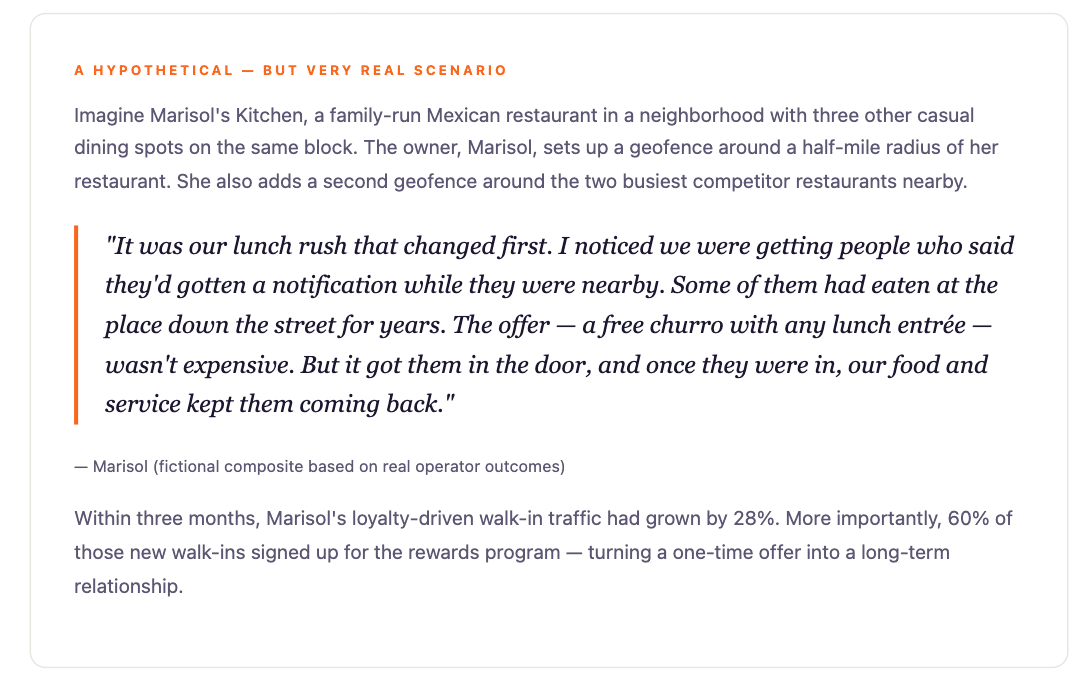
Geofencing lets you draw a virtual boundary around a geographic area — your restaurant, your neighborhood, or even a competitor’s location. When a loyalty member enters that zone with their phone, they can automatically receive a push notification or offer.
Think about what that means in practice: a customer is walking past your block on their lunch break, deciding where to eat. At that exact moment, their phone buzzes: “Your free appetizer is waiting — come in today and redeem it.” That’s not marketing. That’s a perfectly timed reason to walk in the door.
Other ways to reduce customer churn to competitors
- Points that feel meaningful. If customers feel they’d “lose” something by switching, they stay longer. Build your reward structure so reaching the next tier feels genuinely exciting — not like it takes a year of visits.
- Win-back automations. When a regular goes quiet — no visit in 45 days — an automatic message with a compelling offer can re-engage them before they’ve fully become someone else’s regular.
- Exclusive member perks. Early access to new menu items, members-only happy hours, or a VIP table reservation priority. These benefits can’t be replicated by simply going to a competitor, which creates genuine stickiness.
- Consistent communication. Customers who hear from you regularly — not just when you want something — stay emotionally connected. Monthly newsletters, celebration messages, and “just because” offers all contribute to this.